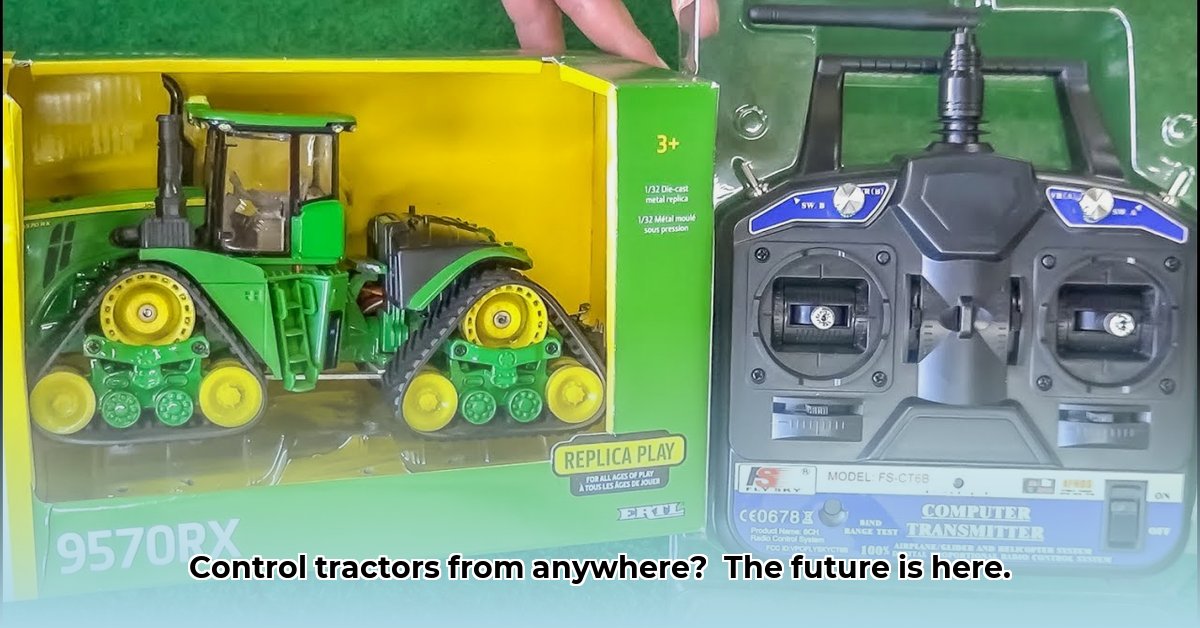
Imagine a farmer, comfortably seated at home, guiding a tractor across their fields miles away using a tablet. This isn't science fiction; remote-controlled John Deere tractors are quietly revolutionizing agriculture. For more on John Deere manufacturing, see this page. While fully autonomous tractors are still under development, the potential to increase efficiency, sustainability, and even profitability is already transforming the industry.
A Glimpse into the Future of Farming
The excitement surrounding remote-controlled tractors stems from their potential to solve many of agriculture's most pressing challenges. Current models offer remote operation, allowing farmers to steer and control tractors from a distance. This offers immediate benefits, but the technology is still evolving. The future likely includes fully autonomous systems, incorporating AI for intelligent decision-making and sophisticated data analytics for optimized farming practices. However, significant advancements are still needed before widespread adoption occurs.
What Can Remote-Controlled Tractors Do Now?
Current remote-controlled tractor technology enables remote operation, but it's not quite fully autonomous. Farmers can steer and control tractors from a distance, offering increased precision and potential for 24/7 operation. Yet, complete autonomy, where tractors make independent decisions, is still under development. One key limitation is reliable internet connectivity in rural areas. Without consistent, powerful internet access, remote operation becomes unreliable and potentially dangerous.
Who's Involved in this Agricultural Revolution?
The development and adoption of remote-controlled tractors involve various key stakeholders:
| Stakeholder | Short-Term Goals | Long-Term Goals |
|---|---|---|
| John Deere & Equipment Makers | Refining remote control systems; conducting extensive field tests; gathering crucial farmer feedback. | Developing fully autonomous systems; integrating AI for smart decision-making; creating comprehensive data analytics platforms. |
| Farmers | Assessing cost-effectiveness; evaluating infrastructure needs; training personnel. | Adopting autonomous operations; leveraging data to improve yields and efficiency; exploring innovative farming techniques. |
| Governments & Regulators | Establishing safety guidelines; developing regulations for remote operation; addressing complex liability issues. | Creating robust data privacy standards; implementing stringent cybersecurity protocols for connected farm equipment. |
| Technology Providers (5G, etc.) | Expanding high-speed internet access into rural areas. | Developing faster, more reliable communication networks for autonomous equipment; creating cutting-edge AI and machine learning systems for precision agriculture. |
The Upsides of Farming from Afar
The potential benefits of remote-controlled tractors are compelling. More precise planting and harvesting minimizes waste and maximizes yields. Farmers can work more efficiently, potentially reducing labor costs and getting crops to market faster. This technology is particularly beneficial for farming in challenging terrains. However, a crucial question remains: Will the substantial investment cost result in a favorable return on investment (ROI) for farmers? This is a key focus of ongoing research.
The Challenges Ahead: More Than Just a Tech Problem
Despite the promise, several hurdles must be overcome before remote-controlled tractors become commonplace. The high cost of the technology represents a significant barrier for many farmers. Adding the need for reliable high-speed internet in rural areas further compounds this challenge. Ensuring safety and security from cyberattacks is also vital. Finally, a clear regulatory framework is needed to address liability and safety concerns.
The Future is Still Being Written
The future of farming is likely to see increased adoption of remote-controlled and autonomous tractors. However, overcoming technological, economic, and regulatory challenges is crucial for widespread implementation. Ongoing research and collaboration are paramount to unlock the technology's full potential. While efficiency and sustainability are significant benefits, long-term economic viability and regulatory clarity are essential for this transformative technology to flourish. The full impact remains to be seen, but it's clear that the future of farming will look significantly different.
How to Assess ROI of Remote Controlled Tractors for Sustainable Farming
Key Takeaways:
- Remote-controlled tractors offer significant potential for increased efficiency and sustainable farming practices.
- A thorough ROI assessment requires careful consideration of various factors, including substantial initial investment, operational savings, and long-term environmental benefits.
- The long-term sustainability gains, such as reduced resource usage, are critical components of the ROI calculation.
- Data integration and analysis enable farmers to understand the technology's true financial impact.
- Collaboration between farmers, technology providers, and policymakers is essential for successful adoption.
A Step-by-Step Guide to Assessing ROI
- Calculate initial investment: Include purchase price, installation, and ongoing maintenance.
- Estimate operational costs: Compare fuel, labor, and repairs against conventional methods.
- Project increased yields: Use data and similar farm examples for realistic projections.
- Quantify reduced waste: Assess savings from reduced inputs (fertilizer, water, pesticides).
- Factor in environmental benefits: Consider potential carbon credits or premium pricing.
- Analyze long-term costs and benefits: Project ROI over a 5-10 year period.
[This is a simplified analysis; comprehensive ROI assessment requires detailed financial modeling. Consult with agricultural economists or technology specialists for more accurate projections.]